

The Ultimate Guide to Can-Air® Pond and Dock De-Icing Systems
Canadian winters can be challenging for pond owners, waterfront property owners, and marina operators. Ice formation, expansion, and movement can place significant stress on docks, boats, pilings and other waterfront structures.
Can-Air® de-icing bubbler systems use compressed air to circulate water, helping manage ice formation around waterfront structures and within ponds and lakes.
How Does a De-Icing Bubbler System Work?
A de-icing bubbler system delivers compressed air through specially designed underwater tubing. As bubbles rise to the surface, they bring deeper, potentially warmer water with them. This continuous water movement can limit ice formation and create openings in existing surface ice.
Unlike traditional heating elements, bubbler systems utilize the existing heat within the water rather than directly heating it.
Several factors influence de-icing performance, including:
- Water temperature and depth
- Outdoor temperatures
- Existing ice thickness
- Airflow and tubing placement
- Natural water movement
Proper system sizing is important to achieve the desired results.
How Effective Is Can-Air® De-Icing Airline?
In November and December 2020, Pond Pro Canada conducted field studies using approximately 5.8 feet (1.78 metres) of de-icing airline in two ponds under different winter conditions. The two ponds (A and B) had water depths of 3.9 m and 4.4 m, respectively. After 30 hours of operation, a single length of de-icing bubbler tubing created an open-water surface area of 71.5 m² in Pond A, with a final water temperature of 0.5°C (Fig. 1), and 182.4 m² in Pond B, with a final water temperature of 2.3°C (Fig. 2). These results highlight how water temperature and site conditions can influence de-icing performance.

Figure 1. Areas of ice-openings (m2) created by 178 cm of linear Pond Pro’s Can-Air De-icing Tubing over a 30-hour time period. De-icing airline was placed at a depth of 3.9 m and initial ice thickness was 10.6cm. Average water temperature at 0 hours was 1.6°C and 0.5°C at 30 hours. Average ambient daytime air temperature over the course of the study was -13°C (low of -18°C). Data collected November 2020.
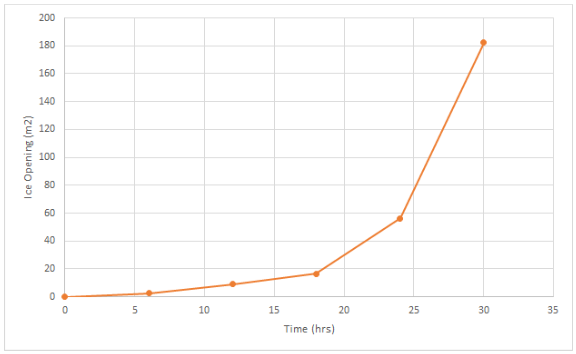
Figure 2. Areas of ice-openings (m2) created by 178 cm of linear Pond Pro’s Can-Air De-icing Tubing over 29 hours. The de-icing airline was placed at a depth of 4.4 m and the initial ice thickness was 19.1 cm. Average water temperature at 0 hours was 2.8°C and 2.3°C at 30 hours. Average ambient daytime air temperature throughout the study was +2°C (low of -7°C). Data collected December 2020.
These results demonstrate the potential of Can-Air® de-icing airline under different winter conditions. Actual performance will vary depending on site characteristics, equipment configuration and weather conditions.
Common Applications for De-Icing Bubbler Systems
Can-Air® de-icing airline can be configured for a variety of residential, commercial and industrial applications, including:
- Residential and cottage docks
- Marinas and boat slips
- Ferry terminals and waterfront infrastructure
- Ponds, lakes and dugouts
- Industrial water storage ponds
- Barges and floating structures
The flexible tubing allows for customized layouts based on the dimensions and requirements of each application.
Choosing the Right De-Icing Bubbler System
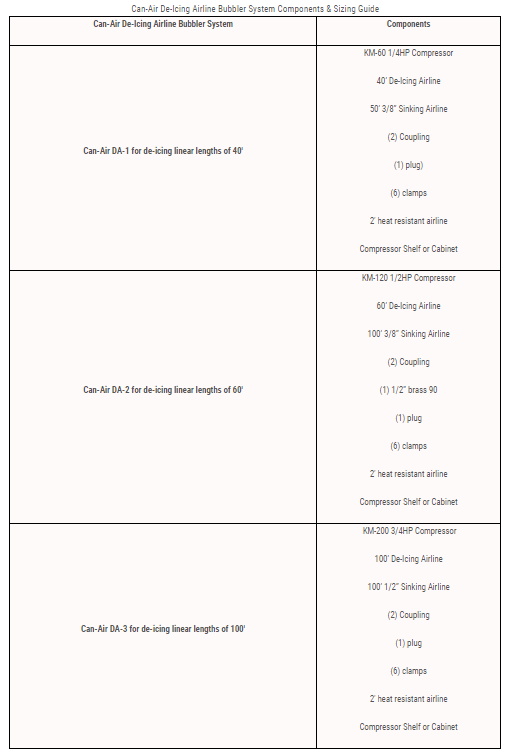
Can-Air® de-icing systems are available in various configurations to accommodate different water depths, tubing lengths and electrical requirements. Standard systems are designed for water depths of at least four feet. Shallower applications may require specialized configurations. As a preliminary sizing guideline, de-icing airline generally requires approximately one cubic foot per minute (CFM) of airflow for every 20 to 40 feet of tubing. Actual requirements will depend on site conditions.
Winter De-Icing Safety
Water circulation can weaken ice beyond the visible open-water area. Never assume that ice surrounding an operating de-icing system is safe. Install appropriate warning signs and barriers, and follow applicable local regulations.
Need Help Sizing Your Pond or Dock De-Icing System?
Whether you are managing ice around a residential dock or designing a commercial de-icing system, Pond Pro Canada can help you select equipment suited to your application. Our team can recommend appropriate compressor sizes, airline lengths and system layouts based on your water depth, property dimensions and winter conditions.
Shop Can-Air® De-Icing Airline or contact our team at sales@pondpro.ca for expert assistance with the following information:
- What type of body of water is this?
- Body of water dimensions (L x W)?
- Water depth (average & max)?
- Water depth at de-icer/bubbler system installation & depth 100 m from proposed de-icing tubing installation?
- Required area of de-icing?
- If there is a water current, what is the speed of the current?
- Coldest design ambient air temperature to account for on-site?
- Power source & location?
- Is there space available for compressors (i.e: a compressor room), or will be they housed outside? If so, how far away from power?
- Do you have a preference for mechanical/propeller de-icing or bubbler de-icing? Are there any concerns with power in the water
- Is there a project deadline?
- Please provide drawings, Google Maps/Earth link, and any additional information that will help us understand and quote this project.
Recent Posts
-
How to Keep Koi Pond Water Clear | Koi Pond Care Canada
How to Keep Koi Pond Water Clear Clear koi pond water is one of the most common goals for backyard p …20th May 2026 -
Why Pond and Lake Water Often Turns Green During Summer Months
For many people who live near the water, the season can start off beautifully. The ice disappears, …15th May 2026 -

Pond Scum in Canadian Ponds: What It Is, Why It Happens, and How to Treat It
What Is Pond Scum? “Pond scum” can be a general term people use for the green, slimy, floating, or s …5th May 2026